

Summary
Film photography maintenance relies on simple, routine cleaning and, periodically, a complete professional overhaul, to ensure your camera remains reliable and accurate in the long term.
Maintenance and repair of film cameras
Most of the film cameras still in circulation are several decades old. This does not make them inherently fragile, but they do require a minimum of attention. Good camera maintenance limits the risk of breakdowns, preserves the accuracy of the mechanism, and avoids many repair costs. Here you will find simple and practical tips on when to clean, when to monitor, and when to call a workshop. To complete your equipment, you can also consult our film photography accessories useful for protection and maintenance.

Camera cleaning: the right steps
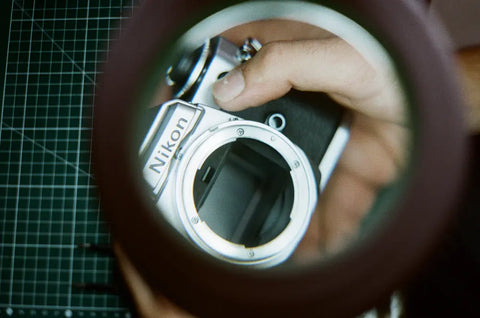
To clean your film camera without taking risks, it is best to keep it simple. Regular maintenance is often enough to prevent dust accumulation and preserve the mechanics, without opening the camera body or intervening on sensitive areas.
- Camera body exterior: remove dust with a soft brush, then wipe with a microfiber cloth. For metal levers and controls, a cotton swab lightly moistened with pure alcohol may be suitable.
- Lens and elements: always start by removing particles with a brush or air blower, then use a product suitable for optical lenses with a clean microfiber. Work without applying pressure.
- Focusing screen and prism: on an SLR, the focusing screen should not be rubbed. An air blower is the safest solution to avoid damaging its coating.
- Back and seals: open the camera, check the grooves, spool, and sealing areas. Gentle cleaning with a cotton swab can remove deposits without forcing.
If you want to clean your camera correctly, also keep a few useful habits in mind: avoid removing the lens during the operation, store your equipment in a dry place, and remove batteries if storing for an extended period.
Common malfunctions in film cameras
A camera may seem to work, then show its limitations as soon as a film is loaded. Over time, lubricants dry up, some parts wear out, and the slightest malfunction becomes more likely. If you are considering having your equipment repaired, our page dedicated to film camera maintenance outlines the repair process.
One of the most frequent defects concerns the shutter. Its curtains must move with perfect regularity. If they become desynchronized, the exposure becomes irregular and bands may appear on the negative, especially at fast speeds. This type of malfunction requires degreasing or recalibration, and specialized measuring equipment.
| Observed problem | Probable cause | Recommended solution |
| Shutter jammed or stuck | Lubricants dried up, springs worn out | Professional overhaul |
| Inconsistent speeds | Curtain desynchronization | Calibration on test bench |
| Light leaks | Degraded light seals | Replacement of seals |
| Systematically blurry images | Misaligned focus | Check and recalibrate |
| Fungus in the optics | Humidity, improper storage | Disassembly and professional cleaning |
Complete overhaul: when and why to entrust it to a professional
If you use your camera regularly, an overhaul every 2 to 3 years is a reasonable baseline. It can include partial disassembly, internal cleaning, restoration of the mechanics, replacement of seals, as well as a check of the light meter, electronics, and film advance. This work allows the camera to regain stable and reliable measurements.
Film camera repair at France Argentique
Our workshop repairs SLRs and rangefinders from brands such as Nikon, Canon, Pentax, Minolta, Olympus, Fuji, and Zenit, produced between the 1960s and 2000s. To repair a camera, a diagnostic fee of €30 is required before any intervention. It includes testing the shutter, checking the diaphragm, focusing, and the light meter. A detailed quote is then provided before the repair. If you prefer to start with an already checked model, you can consult our selection of film SLR cameras.
Whether it's a minor repair or a more extensive mechanical intervention, our technicians replace necessary parts and perform the final check before return. A 6-month warranty covers technical failures after intervention. If you're wondering how to maintain my camera, remember this: it's better to act before a defect worsens.
Frequently asked questions about film camera repair
How much does a diagnostic or repair of a film camera cost?
At France Argentique, a camera diagnostic costs €30. It allows us to precisely identify the cause of a malfunction before any intervention on the camera body.
This check includes testing the shutter, verifying the light meter, lens, focusing, and, depending on the camera's condition, examining the relevant mechanism. A detailed quote is then provided before any camera repair. After intervention, a 3-month warranty covers technical failures.
How often should a film camera be serviced?
For film cameras used regularly, an overhaul every 2 to 3 years is a good baseline.
Over time, lubricants dry out, seals lose effectiveness, waterproofing can degrade, and certain mechanical elements become less regular. This overhaul also allows for internal cleaning, checking the proper function of the shutter, mirror, and light meter, especially on an old camera 40 to 50 years old.
Can you clean a film camera yourself without risk?
Yes, for external cleaning of the camera body and lens, provided you use appropriate tools: a soft brush, an antistatic microfiber cloth, an air blower, and a product designed for lenses. This is sufficient for routine maintenance of many film cameras.
However, it is best to avoid any disassembly. The mirror, shutter, and internal parts require real expertise, especially when a repair, seal replacement, or waterproofing check becomes necessary. If there is any doubt, a malfunction, or an operating anomaly, it is safer to entrust the camera to a technician.