

Summary
Before entrusting your camera to a technician, it is useful to know which models are accepted, what the most frequent breakdowns are, and what a professional intervention on a camera body or photo lens concretely entails.
Repair of analog SLR cameras and lenses
A well-maintained analog camera can remain reliable for decades. When a breakdown occurs, the most important thing is to know if your camera falls within the scope of coverage, and what a technician will actually do to it.

Which analog cameras are covered?
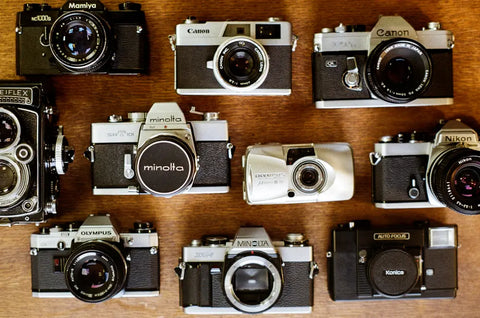
Our repair workshop primarily handles SLR and rangefinder cameras produced between the 1960s and 2000s. The most common brands are accepted, including Fuji, Canon, Nikon, Pentax, Minolta, Olympus, and Zenit. We mainly work on mechanical and electro-mechanical models, which are more suitable for durable refurbishment.
- 24x36 analog SLRs: These are the most commonly serviced models, whether fully manual or semi-automatic cameras.
- Rangefinder cameras: These can also be repaired, subject to prior verification depending on the model.
- Generally excluded cases: Compact cameras, point-and-shoot compact cameras, medium format, and most autofocus SLRs are not typically covered.
If in doubt, the simplest way is to send a repair request. A technician will check the model before proceeding. You will quickly know if your camera equipment can be serviced and under what conditions.
| Category | Supported | Accepted Brands |
| 24x36 Analog SLR | Yes | Canon, Nikon, Pentax, Minolta, Olympus (pure mechanical), Fujica, Zenit, Konica... |
| Rangefinder Camera | Yes | Depending on model, prior verification |
| Analog Compact Camera | No | - |
| Medium Format | No | - |
| Autofocus SLR | Rare exceptions | Depending on model |
Diagnosis and common breakdowns on an analog camera
Before any camera repair, a structured diagnostic is carried out and billed at €30. This check covers the shutter, diaphragm, focusing, and exposure meter. It serves to identify the real cause of the breakdown and to plan for parts, the possible replacement of certain elements, and the intervention time.
- Seized shutter: Over time, lubricants dry up and the mechanism partially or totally seizes.
- Inconsistent speeds: Incorrect curtain adjustment can cause streaks on the negative.
- Light leaks: Worn light seals allow stray light to enter, fogging images.
Other common defects include misaligned focus or the presence of fungus on a lens. This type of optical damage often appears after damp storage. The longer you wait, the more delicate the cleaning becomes.
Interventions carried out on camera body and photo lens
Once the diagnosis is validated, our technicians intervene according to the condition of the body or optics.
- Shutter degreasing: Mechanism re-lubrication and speed adjustment.
- Felt replacement: Replacing the light seals eliminates light ingress on the body.
- Work on optics: Cleaning the lens, treating fungus, and restoring the photo lens when possible.
- Complete overhaul: Ultrasonic cleaning, deoxidation, cell adjustments, and rangefinder check as needed.
Our camera repair service relies on measuring tools and an EF-8000 type test bench to verify the result after intervention.
Warranty, deadlines, and follow-up after camera repair
Each camera repair benefits from a 3-month warranty on technical defects related to the intervention. Normal wear and tear and improper use are not covered. If you want to better maintain your analog camera between workshop visits, you can consult our dedicated guide on camera repair.
For regular use, a check-up every 2 to 3 years remains a good baseline. If you have doubts about a model, the feasibility of a camera repair, or dropping it off in-store, consult the camera repair page.
Frequently Asked Questions about Camera Repair
What is the difference between repairing an analog camera and a digital camera?
The difference lies mainly in their design. A digital camera, whether a simple digital camera or a digital SLR camera, relies on an electronic sensor and often integrated components. When a failure affects these elements, camera repair sometimes becomes impossible or economically unviable.
Conversely, an SLR camera dedicated to analog photography relies on a more accessible mechanical system: springs, shutter, gears, and wear parts can often be inspected, adjusted, or replaced. This is what makes SLR camera repair particularly suitable for older models, even after several decades of use.
In practice, where digital photography quickly reaches its limits in troubleshooting, an analog camera lends itself more naturally to a lasting restoration.
How to submit a repair request and get an estimate?
To submit a repair request, you can use our online form or drop off your camera directly at the repair shop, located at 41 quai Saint-Vincent. This is the simplest solution if you want to find a trusted repairer and get a clear opinion before any intervention.
An initial diagnostic fee of €30 is charged before repairing a camera. It includes shutter testing, diaphragm control, focus verification, and cell inspection. After this, a detailed estimate will be sent to you. No work will begin without your approval.
Camera equipment repair covers labor and necessary parts, with a 3-month warranty. Our repair shop is open from Tuesday to Saturday, from 11 am to 7 pm. Depending on the case, we can work on a camera body, a photo lens, or other elements of your camera equipment.
Can a photo lens also be repaired separately from the body?
Yes. A photo lens can be serviced separately from the camera body. An experienced camera repair technician can perform cleaning, treatment of optical fungus (organic deposits that form on lenses and degrade sharpness), mechanical recalibration, or inspection of a damaged or dirty lens.
This type of intervention requires true expertise. A degraded optic can therefore directly affect the final result.
The troubleshooting process follows a simple path: diagnosis, functional check, targeted intervention, then final validation. However, the service does not cover analog compact cameras or certain medium format lenses. If you have any doubt about the compatibility of your equipment, it is best to send us a repair request with the exact references of the camera or optic.