

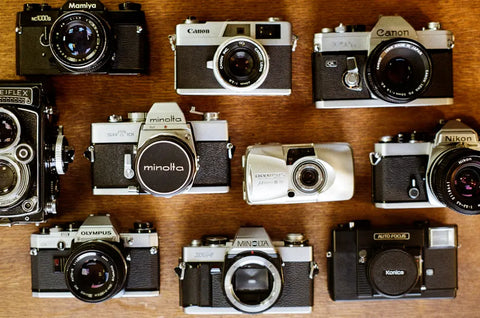
Summary
Here you will find an overview of the flagship film camera models of the 1970s, their technical characteristics, and the essential criteria for choosing the vintage body that will best support your photographic approach.
Iconic Film Cameras of the 1970s
In the 1970s, the convergence of reliable mechanics and early electronic automation produced accessible and durable cameras, some of which became benchmarks. You will find a revised and guaranteed selection in our shop.

Canon AE-1 and Nikon F2: Two Flagship SLRs
Launched in 1976, the Canon AE-1 remains the camera of that decade most readily cited first. Its embedded microprocessor, shutter-priority mode, and wide range of FD lenses (from 15mm fisheye to 800mm) make it an evolving companion.
In contrast, the Nikon F2 pushes robustness further: 1/2000s shutter speed, all-metal chassis, and lasting compatibility with the F mount. For those who want to build a sustainable optical system, this is a strong argument.
- Smooth Progression: switch from automatic to manual exposure without changing bodies.
- Open Mount: dozens of quality lenses available on the used market.
- Robust Construction: great mechanical reliability and parts still available for maintenance.
You will find more detailed purchasing advice in our dedicated guide to 1970s cameras.
Polaroid SX-70 and Hasselblad 500 C/M: Instant and Medium Format
The Polaroid SX-70 (1972) shook up conventions: self-developing film, through-the-lens reflex viewing, and an elegantly folding design. It allows the image to appear before your eyes and permits creative manipulation of the still-fresh emulsion.
In contrast, the Hasselblad 500 C/M established itself in the 6 × 6 cm medium format world. This fully modular system offers high-quality interchangeable optics and negatives with remarkable tonal richness. It is a classic of film photography that continues to be used by demanding portrait and landscape photographers.
Flagship Models of the 1970s by Use
The following table groups the flagship models of the 1970s by use.
| Category | Iconic Model | Film Format | Main Asset |
| SLR | Pentax K1000 / Nikon F2 | 35 mm | Versatility, vast lens range |
| Compact (Point & Shoot) | Konica C35 EF | 35 mm | Daily discretion |
| Rangefinder | Yashica Electro GX | 35 mm | Clear viewfinder, fast focusing |
| Twin-Lens Reflex (TLR) | Rolleicord IV | 120 | Soft portraits, waist-level viewing |
| Polaroid | Polaroid SX-70 | Instant Film | Immediate development |
How to Choose Your 1970s Film Camera?
To start or improve, the ideal is to consider your personal practice: do you enjoy posed portraits, spontaneous reporting, or travel photography? A semi-automatic 35mm SLR offers an excellent transition for learning to master exposure. Meanwhile, a compact and lightweight body will easily slip into your bag to accompany you every day.
When making your choice, the mechanical condition of the camera should be your primary criterion. Take the time to test the shutter's fluidity at slow speeds, the proper functioning of the self-timer, and the condition of the curtains. Also, examine the lens for any scratches or signs of fungus, and check the flexibility of the light-tight foam seals. If you prefer to avoid unpleasant surprises, a model already serviced by a professional remains a very reassuring option. Our film camera repair service is available to diagnose, service, and guarantee your cameras for three months to ensure their continued use with peace of mind.
Frequently Asked Questions
Which camera was most popular in the 1970s?
If only one camera could be chosen, it would be the Canon AE-1 (or canon ae-1 for lowercase enthusiasts). Released in 1976, it made the 35mm SLR accessible: integrated light meter, easy-to-understand shutter priority, FD mount open to a wide range of lenses. The Nikon F2, more robust and designed for professionals, and the Pentax K1000, renowned for its excellent value for money, complete this selection of choices. All three exude a retro style and remain safe bets for practicing film photography with confidence and a reliable camera.
What film format does a 1970s camera use?
Nine times out of ten, you'll load 35mm. This format, born for quick shooting, remains the most affordable and widely distributed in color or black and white film. Some vintage cameras (twin-lens reflexes, folders, or certain professional SLRs) use 120mm, known as medium format. The negatives are two to three times larger, offering generous definition and softer background blur, at a slightly higher cost per image. If you are new to your first film camera, we recommend sticking to 35mm: it is easy to find, extensively documented, and ideal for learning before exploring new horizons.
How to check if a vintage 1970s camera is in good condition?
Take the time to check the mechanics. Trigger each speed: the difference between 1/1000s, 1/60s, and 1s should be audible to the ear. Then move on to the optics: under grazing light, with the aperture open, look for haze, scratches, or fungus in the lens. Open the back, then feel the foam seals that ensure light-tightness. If they are brittle or sticky, they will let light leak in and fog your film. Finally, operate the film advance lever: it should be firm, with no hard spots. Always demand a precise description from the seller and, if possible, a real film test before finalizing your purchase.