

Summary
- Iconic Film Cameras of the 90s
- Old Cameras and Disposable Kodaks: What You Need to Know Before Buying
- Starting and Progressing in Vintage Film Photography in 2025
- Frequently Asked Questions
Looking for a 90s camera? Here's what you need to know to understand the iconic models of that decade, distinguish them, and choose the right one for your skill level and desires. These tips provide concrete benchmarks, from selecting the camera body to purchasing used.
Iconic Film Cameras of the 90s
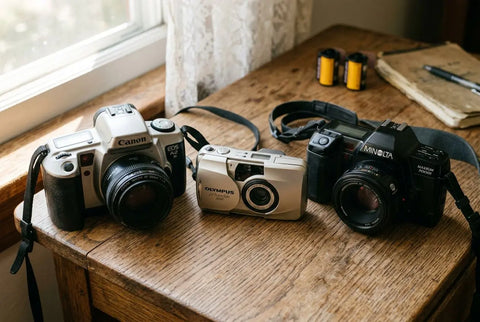
The 90s hold a special place in the history of photography. It was a time when film cameras became more accessible, when 90s compact cameras became widespread, and when SLR cameras modernized without losing their educational value. For those who love vintage photography, this period remains very rich, and beautiful models can still be found on the used market today.

Canon, Nikon, Olympus: The Great Vintage Camera Brands
When looking for a 90s camera, certain brands naturally come to mind. Canon, Nikon, Olympus, Minolta, Pentax, and Contax each offered remarkable camera bodies, in both compact and SLR photography. Their common traits: solid construction, good optics, and true user consistency.
- Canon EOS 500N (1995): Compact and intuitive autofocus SLR, perfect for getting started with 90s photography. Can be found between 80 and 180 euros with a 35-80 mm lens.
- Nikon FM2n: Robust mechanical SLR, highly prized by demanding photographers. Reliable, durable, and its results remain remarkable.
- Olympus Mju II (1997): High-end 90s compact point & shoot, renowned for its exceptional optics and discretion.
- Contax RTS III (1993): Professional SLR with a high-end Zeiss lens, for advanced technical requirements.
- Yashica T4 (1990): Automatic point & shoot with Zeiss optics, robust and accessible.
If you wish to purchase a serviced camera body, you can consult this selection of 90s cameras, with different types of bodies and formats, from 35mm to medium format.
Vintage Cameras: Compact or SLR? How to Choose
In the 90s, two families dominated. On one hand, the 90s compact camera, easy to carry, often equipped with an automatic built-in flash and a fixed focal length. On the other, the SLR camera, more versatile, allowing for lens changes and better exposure control.
The right choice mainly depends on your practice. If you want to learn, understand the effect of shutter speed, aperture, or film sensitivity, a 35mm SLR is often the most educational. If you're looking for a light, spontaneous camera that's easy to slip into a bag, a compact camera will often be more suitable.
You also need to consider your current habits. If you come from digital or digital cameras, an automatic compact will immediately feel familiar. Conversely, if you like to take your time and understand what your camera is doing, an SLR will give you more control.
Why 90s Vintage Cameras Are Still Appealing
With a film camera, the number of shots is limited and the cost of each roll of film is real: this naturally encourages more careful framing before shooting.
The rendering also plays an important role. Grain, contrast, small imperfections, sometimes softer or denser colors: film photography retains a character that digital often tries to imitate. This explains the lasting interest in these cameras, whether it's an SLR camera, a compact, or a rarer model among vintage cameras.
Old Cameras and Disposable Kodaks: What You Need to Know Before Buying
Looking for a film camera, but the used market intimidates you? Let's get some bearings. Between a disposable Kodak, instant Polaroids, a folding Zeiss Ikon, or a 90s Canon SLR, the offer is vast. Each camera has its strengths, its limitations, and its points of vigilance.

The Kodak Disposable Camera: The Simplicity of the Built-in Flash
The disposable Kodak remains one of the most accessible cameras for starting out in film photography. It comes pre-loaded with a 24 or 36 exposure color film, with a fixed lens and a built-in flash that recharges with a simple wheel: nothing to adjust, just shoot. For a birthday, a festival, or a wedding, this format is always popular. Yes, these cameras are worth it, especially if you want to discover film photography without investing too much.
One point deserves your attention: check the film's expiration date. Beyond ten years, colors can shift and the flash can lose power. It's better to choose a recent one or have the camera reloaded by a specialized lab.
Polaroid and Zeiss Ikon: Two Icons to Rediscover
Polaroid SX-70: An elegant folding camera, with an SLR viewfinder and instant prints. Expect to pay €120 to €300 depending on the condition. The chemicals cost about €2 per photo, a point to keep in mind before shooting.
Zeiss Ikon Nettar: Medium format 6x6 or 6x4.5, folding bellows, Nettar or Novar optics. Lightweight, all-metal, between €50 and €150. It requires measuring exposure with a light meter or by estimation, but the image quality, especially with modern film, often remains astonishing.
90s Canon, Nikon, or Minolta SLRs
For versatile use, a 35mm SLR remains a very solid choice. A Canon AE-1, a Nikon F3, or a Minolta X-300 accepts many lenses and a dedicated flash. Before buying, observe the camera body: no impacts, intact mirror foam, and especially a consistent shutter at all speeds.
Starting and Progressing in Vintage Film Photography in 2025
Film photography has a simple virtue: it forces you to slow down. Every image counts, every exposure is thought about a little more, and that's often what leads to progress. To get started well, it's best to choose a camera that matches your use, understand the right film format for you, then adopt some maintenance habits to keep a reliable camera over time.
Which Film Camera to Choose to Start Vintage Photography
To enter the world of vintage film photography, a semi-automatic 35mm SLR film camera often remains the most reassuring choice. It allows you to be quick when necessary, while leaving room to learn the basics of photography at your own pace. You can start in aperture priority or semi-assisted mode, then switch to manual without changing cameras as you progress.
If you want to explore the most sought-after models of this period, this guide on 80s vintage cameras can help you spot good comparison points before buying.
- Minolta X-300: An excellent entry point, easy to handle, reliable, and very comfortable with 35mm film.
- Canon AE-1: A great classic by Canon, appreciated for its exposure metering, lens compatibility, and solid reputation.
- 90s compact camera: Practical, lightweight, often equipped with a built-in flash, ideal if you want to photograph without getting lost in settings.
Retro cameras and 35mm vintage cameras are the easiest to find used. It's also the simplest format to start with: the offer is wide, prices remain reasonable, and you'll easily find film.
Kodak, Polaroid, or SLR: Which Film and Which Format to Choose
The choice of film has a direct impact on your experience and image quality. In practice, 35mm is the best starting point: film is easy to find, development is common, and most beginner cameras accept it. If you want a more expansive look, 120 film opens the door to medium format, with a more generous image and a slower approach.
- 35mm film: The most flexible standard to start with, compatible with many SLRs and compact cameras.
- 120 film: A larger negative, often sought after for its sharpness and richer rendering in film photography.
- Polaroid instant film: For an immediate image, a recognizable look at first glance, and a unique practice in the vintage universe.
From Kodak, you can find very accessible 35mm references for beginners. A sensitivity of 400 ISO is suitable for most situations, indoors and outdoors, especially if your camera has a flash or a built-in flash. Polaroid, on the other hand, fulfills a different desire: less versatile, but very appealing if you're looking for a true vintage photo aesthetic.
Maintaining Your Vintage Film Camera So It Lasts
Good film camera maintenance doesn't require complicated actions. However, it does require a bit of regularity. Operate the shutter from time to time, keep the camera in a dry place, avoid temperature fluctuations, and monitor the condition of the light seals.
Before loading a new film, check the inside of the camera, the cleanliness of the mirror if you're using a film SLR, and the general condition of the optics. On an old camera that has never been serviced, the most common problems are known: fatigued foams, imprecise speeds, hesitant light meter. A thorough service often suffices to restore true consistency to the whole. This mechanical technology is robust, but it doesn't always forgive neglect.
Frequently Asked Questions
What was the best camera of the 90s?
There is no single "best" universal model: it all depends on what you plan to do. To discover film photography and experience vintage photography, a Canon AE-1 or a Minolta X-300 remains a safe choice: simple, reliable, inexpensive. If you're looking for a discreet camera to slip into a pocket, the Olympus XA2 dominates the 90s compact camera category thanks to its tiny size and excellent optics. For a robust and versatile SLR, the Pentax K1000 or the Olympus OM-4Ti offer remarkable handling and great reliability. At the high end, precision enthusiasts might look for a Leica M6, a Contax RTS III, or a Canon EOS 3 paired with Zeiss Planar 50mm f/1.4 lenses: the construction is impeccable, the viewfinder incomparable. Choose a camera that matches your practice rather than its legendary aura.
Which compact cameras would you recommend from the 90s?
Compact cameras from this decade focus on simplicity: you load a 35mm film, frame, shoot, and the camera does the rest. Among the most sought-after are:
- Olympus XA2: 135 g, 35 mm f/3.5, zone focusing, reliable light meter, no zoom, thus consistent image quality.
- Canon Sure Shot AF-7: 235 g, 38 mm f/2.8, precise autofocus, auto flash, decidedly vintage look.
- Nikon L35AF: recognized robustness, 35 mm f/2.8 treated for contrast, very accurate automatic exposure.
- Ricoh FF-90: bright 40 mm, metal body, practical front exposure corrector.
On the used market, check the proper functioning of the flash, the smoothness of the film advance, and the condition of the light seals before buying.
How to check if an old camera still works?
Before loading your first roll of film, follow this short checklist:
- Shutter: Fire it at all speeds. A crisp click, without hesitation, is a good sign.
- Lens: Shine your phone's flashlight through it. No fog, no fungus, no scratches? You're good on the optics side.
- Mirror and curtains: On an SLR, check that the curtains tension properly and that the mirror doesn't get stuck.
- Light seals: If they are crumbling, plan for a replacement to avoid light leaks.
- Electronics and flash: Insert a new battery. Does the display light up, does the flash charge without difficulty? Perfect.
A quick test during purchase doesn't replace a complete overhaul, but it already rules out most unpleasant surprises. For a worry-free purchase, favor a seller who guarantees the camera for at least three months: this is proof that they checked the film camera before offering it for sale.