

Summary
- Popular Film Cameras of the 80s
- Choosing Your 80s Vintage Film Camera
- Buying and Maintaining Your 80s Film Camera
- Frequently Asked Questions about 80s Film Cameras
This guide helps you identify the best 80s cameras, understand their differences, and choose the film model that truly suits your practice. Find our carefully selected, serviced, and guaranteed 80s cameras in our online store.
Popular Film Cameras of the 80s
With the 1980s, film photography became part of everyday life. Major brands simplified use without compromising optical quality: the SLR system became widespread, compacts fit in a pocket, and Polaroid perpetuated instant photography. Everyone found the tool that matched their way of seeing.

From Polaroid to SLR, a Decisive Decade
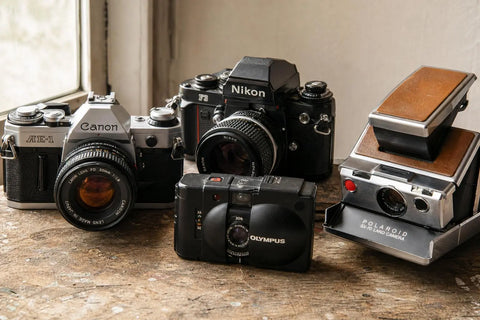
Every 80s camera carried a strong idea. The Polaroid SX-70, launched in 1972 but a star of the following decade, printed images in minutes: no lab, just the film developing before your eyes. In contrast, a 35mm SLR camera offered total control thanks to direct viewing and interchangeable lenses. Two opposite approaches, one shared pleasure: that of creating on film.
Between these extremes, the compact camera became lighter: its zoom or fixed lens, and sometimes a built-in flash, reassured travelers. The rangefinder, slower but precise, appealed to those who liked to take their time.
Cult Brands and Iconic Models
Notably, these iconic models:
- Canon AE-1: the first consumer SLR controlled by a microprocessor, compatible with over 50 FD lenses.
- Nikon F3: legendary robustness, refined mechanics, adopted by many reporters.
- Minolta X-300: the best price/quality balance to discover 80s film photography without risk.
- Olympus XA: discreet gem, bright fixed optics, perfect street companion.
Want to go further in your choice? Our guide dedicated to 80s cameras details each criterion: format, budget, desired experience.
Understanding the Major Camera Families
To help you compare these different approaches to photography, here is a summary of each system's characteristics:
| Camera Type | Film Format | Expertise Level & Focus | Main Advantage |
| 35mm SLR | 35mm | All levels (Manual or Automatic) | Varied lenses, total control |
| Compact Camera | 35mm | Beginner (Automatic or Fixed) | Lightweight, ready to shoot |
| Rangefinder | 35mm | Intermediate to Expert (Manual Rangefinder) | Clear viewfinder, precise focus |
| Medium Format | 120 | Experienced Amateur to Expert (Manual on ground glass) | Large negative, rich rendering |
Choosing Your 80s Vintage Film Camera
Looking for the ideal body? First, forget about simple popularity. A film camera is judged by its use, handling, and actual condition, much more than by its legend alone. Here’s a clear guide to sorting, comparing, and, most importantly, choosing a model that will make you want to go out and shoot right away.

SLR, Compact, or Medium Format: Where to Start?
An old camera is always a bit intimidating. However, the semi-automatic 35mm SLR remains the simplest entry point: it offers automation when you want to be quick and a manual mode to learn focus, aperture, and speed at your own pace. The famous Canon AE-1 illustrates this well, but it's not alone:
- Semi-automatic 35mm SLR, Interchangeable lens, built-in light meter, wide choice of ISO 100 to 800 film. Perfect for progressing.
- Compact film camera, Lightweight, fixed lens, built-in flash. Ideal for walks and everyday vintage Kodak-style photos.
- 120 Medium format, Larger negative, velvety rendering, distinct retro style. Requires a bit more attention... and film budget.
- Rangefinder, Clear viewfinder, precise manual focusing, quiet shutter release. For those who like to take their time.
Points to Check Before Buying a Used Camera
Whether you find a 70s camera inherited from a parent or a vintage Kodak camera at a flea market, a few quick checks can prevent many disappointments. They apply to all film cameras, small or medium format.
- Shutter: Speeds should click cleanly, from 1s to 1/1000s. No audible lag.
- Light seals: Crumbling foam? Guaranteed light leaks. Plan for an inexpensive replacement kit.
- Lens: Fungus, haze, or scratches affect sharpness. Examine under a lamp before buying.
- Diaphragm: Clean blades, smooth movement. A sluggish diaphragm will affect exposure.
The Unique Pleasure of Film Photography
Shooting film means embracing a deliberate pace. You choose your film, consider the format, set the ISO, then press the shutter. The small imperfections—grain, vignetting, sometimes uncertain colors—forge that film photography look that no digital sensor truly replicates.
This constraint has an unexpected effect: it encourages better framing and more careful exposure, because each shot has a real cost.
Find a body in good condition, check the seals, load a versatile ISO 400 film, and do your first test before committing to a model.
Buying and Maintaining Your 80s Film Camera
Before you get out your credit card, here are the points that make the difference between a smooth purchase and a costly disappointment.
1. Where to find a serviced and guaranteed film camera?
An 80s camera is still robust, but forty years of use (or storage) often leave traces: inaccurate shutter speeds, crumbling light seals, misaligned focus. Buying "as is" without a guarantee is like playing the lottery. It's better to choose a seller who:
- accurately describes the real condition of the body and optics;
- performs a complete check before sale;
- offers a written warranty covering at least mechanical failures.
This is the positioning of France Argentique: 80s camera repair:
- Diagnostic at €30: detailed examination, speed measurement, diaphragm and flash check.
- Complete overhaul: lens cleaning, autofocus (or manual focus) adjustment, seal replacement, light test at various ISO values.
- 6-month warranty on parts and labor.
- Physical store established since September 2025 at 41 Quai Saint-Vincent for purchase, drop-off, or pick-up.
In the window: 51 serviced models, from 24x36 SLRs to rangefinders, in 35mm or 120 format. Canon, Nikon, Minolta, Leica... Payment in four interest-free installments via PayPal, delivery within France and internationally.
2. Maintenance: extending the life of your film camera
A few simple steps are enough to preserve your equipment:
- Regularly actuate the shutter to keep the mechanism fluid.
- Store the camera in a dry place, away from temperature variations.
- Before each new film, check the light seals and the cleanliness of the mirror.
If your camera hasn't seen a workshop in ten years, a preventive service remains the life insurance for your film.
3. Kodak and Co. Film Cameras: Pre-Purchase Checklist
Whether it's a Kodak film camera, a Minolta SRT, or an Olympus OM, the checklist remains the same:
- Mechanics: the shutter must fire at all speeds without sticking.
- Optics: free of fungus, deep scratches, and haze.
- Functions: autofocus (if present), zoom, flash, and self-timer must respond.
- Electronics: light meters and LED/LCD displays must be operational, otherwise it's impossible to set ISO or exposure.
Always ask for an "accepted return" clause or go through a workshop that stakes its reputation.
4. Format, Film, ISO: Choosing the Right Camera-Film Combination
35mm color, 120 black and white, 400 ISO for indoors or 100 ISO for outdoors: the film format and sensitivity influence the rendering as much as the camera body. Even a simple disposable camera, if well-chosen, can offer a truly vintage Kodak photo.
Are you tempted by Polaroid photography? Keep in mind that the integrated chemistry becomes expensive to use. For beginners and those looking to progress, a serviced SLR remains the most versatile model: interchangeable lenses, shutter speed control, precise focusing.
5. Your Next Step
List two or three models that match your budget and practice. Check their availability in a serviced and guaranteed version. Then choose a film suitable for the light conditions of your future outings, load your camera, and take your first pictures.
Frequently Asked Questions about 80s Film Cameras
What were the most popular cameras of the 80s?
Among the most well-known models of the 80s are the Canon AE-1, the Nikon F3, the Minolta X300, and the Olympus XA. The Canon AE-1 remains an excellent choice for discovering film photography, as this model is easy to use, well-documented, and compatible with many lenses. The Olympus XA is popular for its compact size, while the Nikon F3 is aimed more at those looking for a more robust and durable film camera.
How do you know if a vintage film camera is in good condition?
Start by checking the shutter at various speeds, the condition of the light seals, the cleanliness of the lens, and the proper functioning of the diaphragm. On an old camera, worn seals or inaccurate speeds can damage or fog the film. If you want to limit unpleasant surprises, it's better to choose a specialized seller who offers a serviced and guaranteed vintage camera.
Can an 80s film camera still be used today?
Yes, without a problem. A well-maintained 80s film camera can still be used for a long time. 35mm film is still easy to find, and many labs still develop this format. A vintage camera from this period, whether an SLR or a compact, can therefore offer a very good film photography experience today, especially if the model has been serviced.