

Summary
Choosing an analogue photography book is not insignificant: depending on your level and desires, options range from practical guides to reference treatises, and not all meet the same need. You might be looking for a resource to learn from scratch, progress in color development, or keep a useful book handy both in the darkroom and in the field.
Which book to choose for learning analogue photography?
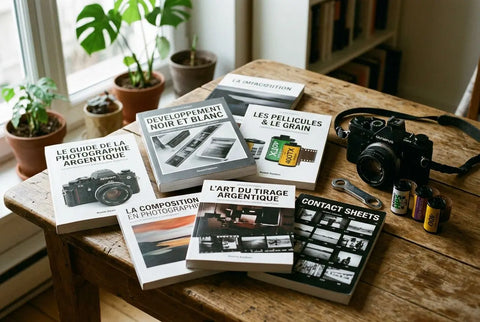
There are about twenty titles in large hardcover format and about ten in digital, from practical guides to reference treatises. Before buying, clarify your needs: do you want to learn photography step-by-step, delve into digitization, or review the basics of exposure? Our analogue photography guide can already give you a first reference point, to then be supplemented with a more targeted book.

Criteria for a good analogue photography book
A reliable book covers the entire analogue chain: equipment, shooting, film choice, development, negatives, printing, and archiving. The most useful books combine illustrated step-by-step instructions, clear diagrams, and practical examples from photographers' experiences. Also check a simple point: the advertised level should match yours. A beginner doesn't need to immediately delve into very technical chapters on printing or alternative processes, while an already proficient reader will look for more technical precision.
Photography books for absolute beginners
To approach analogue photography calmly, choose clear text without unnecessary jargon. A good beginner's book should explain basic gestures with concrete examples. You can also supplement this with our article " how to start analogue photography ".
- Camera body: difference between a manual SLR and an automatic model, the advantage of 35mm to start. To learn more: check out our selection of certified used cameras in store.
- Film: concrete recommendations, Ilford HP5+ in black and white, Kodak Gold 200 in color. Available online and in our physical store at 41 Quai Saint Vincent.
- Exposure: basic triangle, Sunny 16 rule, impact of light. Tips for proper exposure should be immediately testable.
- First darkroom: kit selection, list of development equipment, detailed steps.
Books to deepen your analogue practice
Once the basics are in place, it becomes useful to aim for more precision: understanding emulsion, exploring pinhole photography, working on color development, or comparing lenses. Intermediate or advanced books primarily provide methodology: comparison tables, more technical diagrams, feedback from experience, and sometimes detailed darkroom protocols. If you are already making regular progress, choose a book focused on a single skill rather than a generalist title that repeats what you already know.
Among the essential references, you can turn to The Negative by Ansel Adams to master exposure and development, Film: A World History by Mark Cousins to explore the history of film, or The Manual of Photography for a technical and practical approach. These works offer both depth and clarity.
| Level | Topics covered | Recommended format |
| Beginner | Camera body, film, exposure, darkroom | Large illustrated format |
| Intermediate | Exposure triangle, negatives, composition, film | Large format or ebook |
| Advanced | Zone System, printing, pinhole, cross-processing | Specialized technical manual |
Formats and prices
The large hardcover format often remains the most comfortable to consult in the workshop, especially when the book contains diagrams, negative sheets, or development steps. The digital format can be useful when traveling, or to quickly find information on a phone or tablet. In terms of budget, prices start around €13. At this price, it's better to prioritize a precise work on the topic you really need, rather than a very general book that risks staying on the shelf.
Frequently Asked Questions
What is the best analogue photography manual for absolute beginners?
If you're starting from scratch, look for a truly progressive analogue photography manual. It should help you understand the basics without overwhelming you with technical jargon: camera body choice, film type, exposure, and initial shooting reflexes. A book focused on the 35mm format, with simple examples and practical exercises, will often be more useful than an overly theoretical work.
The most important thing is the method. Read a little, then practice immediately. That's how you truly retain knowledge. To progress with confidence, this back-and-forth between reading and practice remains the most solid approach.
Is one book enough to understand the entire analogue photography workflow?
Yes, a good book can offer a clear overview of analogue photography. It can guide you from film selection to printing, including shooting, developing, and reading negatives. Some titles even go further with chapters on digitization, which is very useful if you want to share your images or archive them easily.
However, a single book is not always enough to cover all topics. The darkroom, advanced exposure, or practices specific to certain formats sometimes warrant a complementary work. To learn sustainably, the good benchmark remains simple: start with a comprehensive guide, then delve deeper according to your practice and questions.
How to choose between a digital book and a large printed format for learning analogue photography?
For beginners, the large printed format is often the most comfortable. Diagrams are more legible, images are more illustrative, and you can keep the book open beside you during a development session. It's a very concrete support when you want to learn step-by-step with a photo manual.
Digital has other qualities. It allows you to quickly find information, consult a passage while traveling, and always have an analogue photography manual at hand. The right choice primarily depends on your reading habits, your workspace, and your way of practicing photography. If you often handle your equipment, chemicals, or negatives, paper generally remains more pleasant. If you like to annotate, quickly search, or reread anywhere, digital also works very well.