

Summary
- Preparing to clean your film camera body
- Cleaning the lenses and the inside of the camera
- Professional servicing and long-term preventive maintenance
- Frequently asked questions
Maintaining a film camera requires a few good habits: here's how to clean the body, care for the lenses, limit marks, and know when to call a professional for a service.
Preparing to clean your film camera body
A film camera from the 1970s to 1990s remains a precision mechanical device. Over time, lubricants dry out, some greases shift, and foams eventually degrade. Regular maintenance helps slow these effects and prevent breakdowns that can sometimes be costly to repair.

Essential tools for proper cleaning
Before cleaning, set up in a clean, quiet place. There's no need to use overly powerful compressed air, which can push dirt further in or move residue to sensitive areas.
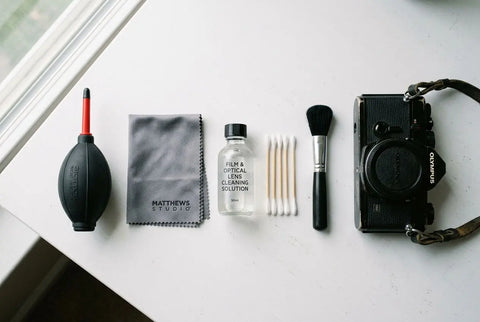
- Microfiber cloth: to wipe exterior surfaces without scratching, provided it's clean and dry.
- Soft brush and blower: useful for removing dust before any contact. The blower is especially helpful in corners and around controls.
- Cotton swabs and isopropyl alcohol: practical for nooks, the lens mount, and some greasy marks. Use alcohol sparingly.
- Lens cleaner: suitable for optical surfaces, it respects lens coatings better than household products.
Avoid paper tissues, kitchen towels, and household products. They easily leave marks or cause fine scratches. If you're looking for suitable equipment, you'll find useful film camera accessories for film camera maintenance.
Cleaning external surfaces step-by-step
To clean your film camera safely, always start dry. First, brush the camera body with a soft brush, then use the blower to remove dust from hard-to-reach areas. This step prevents rubbing particles onto surfaces.
You can then wipe the exterior with a microfiber cloth. For corners, controls, or the lens mount, use a cotton swab very slightly dampened with isopropyl alcohol. If you see grease marks, go gently. Several light passes are better than rubbing too hard.
Common mistakes to avoid
The most important rule is simple: never spray a product directly onto the camera. First apply it to the cloth or cotton swab. This habit greatly reduces risks during cleaning.
Also keep in mind that good maintenance doesn't solve everything. If the shutter becomes erratic, if the film advance sticks, or if certain controls feel abnormal, it's best to entrust the camera to a professional. A service is the right solution when a simple cleaning is no longer enough.
Cleaning the lenses and the inside of the camera
The inside of a film camera requires more caution than its exterior. The lens elements, a reflex camera's mirror, the viewfinder, and the film chamber are sensitive. A hasty movement can leave permanent marks, sometimes impossible to correct.

How to clean lenses without damaging them
To properly clean a lens, always start dry. First, remove dust with a blower or a very soft brush before using any product. Rubbing too early can turn a particle into a micro-abrasive and scratch the lens.
Then, put a few drops of lens cleaner on a microfiber cloth, never directly on the lens. Wipe with gentle movements, from the center outwards, without pressing. In practice, regular and measured maintenance protects better than aggressive or unnecessary repeated cleaning.
Mirror, viewfinder, and film chamber of an SLR
If you're wondering how to clean a film camera mirror, remember a simple rule: no contact. An SLR's mirror has a very fragile surface. To clean it, use only air from a blower. In the vast majority of cases, this is sufficient.
The viewfinder can be cleaned very delicately on its accessible parts, with a cotton swab barely moistened with isopropyl alcohol. In the film chamber, carefully remove dust from the edges and the pressure plate, without touching the shutter curtain. Finally, put the caps back on after use and store the camera in a dry place to limit humidity.
Professional servicing and long-term preventive maintenance
Home cleaning has its limits. For certain operations, such as relubrication, replacement of internal parts, or shutter adjustment, precise tools and real expertise are required. This is exactly the role of a professional service.
When to entrust your camera to a professional
Maintenance of a film camera becomes necessary as soon as unusual signs appear. It's better to act early than to have to repair a broken camera urgently at the wrong moment.
- Mechanical blockages: stiff shutter release, irregular film advance, or controls that offer abnormal resistance.
- Image defects: dark or light bands, unexplained overexposures, or light leaks caused by worn seals.
- Visible degradation: disintegrating foams, sticky residues, marks on internal surfaces, presence of fungus or mold on a lens.
Our film camera repair service offers an initial diagnostic for around €30 to precisely identify the problem before any repair. You can entrust your equipment to our workshop via our film camera maintenance service, with a clear quote and a 3-month warranty.
What a full service includes
A full service includes disassembly, mechanism inspection, application of appropriate lubricants, shutter speed adjustment, verification of the aperture, rangefinder, or light meter depending on the model, as well as replacement of light seals. On an SLR, checking the mirror is also an important point. Each intervention is then covered by a 3-month warranty on technical faults.
| Intervention | Do it yourself | Professional required |
| External body cleaning | Yes | No |
| Lens cleaning | Yes, with caution (outer lens) | If fungus is present (inner lens) |
| SLR mirror cleaning | Air only | If marks persist |
| Mechanical relubrication | No | Yes |
| Shutter calibration | No | Yes |
| Light seal replacement | No (Yes, after tutorial) | Yes |
Good daily storage practices
Regular maintenance limits wear, extends time between workshop visits, and preserves the proper functioning of both the camera body and the lens.
- Battery removal: If not used for an extended period, remove batteries to prevent contact oxidation.
- Dry storage: Keep your film camera in a well-ventilated area, ideally between 40% and 50% humidity, with silica gel to prevent fungus and mold.
- Thermal protection: Avoid high heat, car trunks, and direct sunlight, which degrade lubricants and accelerate the aging of parts.
In practice, a service every two to three years and a few simple daily actions are often enough to keep equipment reliable and avoid major repairs.
Frequently asked questions
What is the price of a professional repair or cleaning for a film camera?
An initial diagnostic costs around €30, which allows for a quote to be established before any work is done. Then, the price of a repair depends on the work required: foam replacement, servicing, relubrication, shutter adjustment, or other technical cleaning. To have a 24x36 film SLR repaired or to entrust the camera body to a professional, our workshop welcomes you at 41 Quai Saint Vincent. Each repair is covered by a 3-month warranty on technical faults.
How often should I clean my film camera?
To clean your camera without damaging it, a light wipe after each use is usually sufficient for the body. You can also carefully clean the external surfaces of the lens if marks become visible. However, deep camera maintenance should be measured: a full service every two to three years is a good baseline for regular use. It's best to avoid overly frequent or forceful actions, especially on optics.
How can I protect my lens against fungus and humidity?
Fungus and mold mainly appear when a lens remains in a poorly ventilated area with too much humidity. Store your optics in a dry place, ideally between 40% and 50% relative humidity, with silica gel packets replaced regularly. If marks are already visible, it's best not to attempt to repair or clean it yourself: entrust the lens to a professional for appropriate cleaning or repair if necessary.