

Summary
- Why choose a refurbished film camera
- Which film camera to choose based on your use
- Photo formats and models to compare
- Frequently asked questions
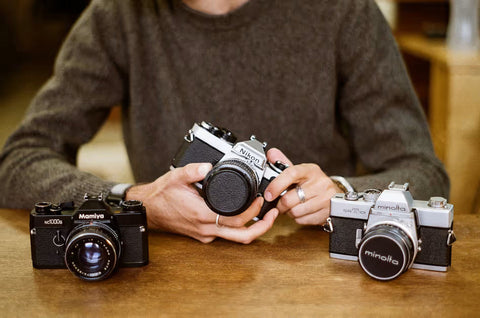
You are looking to buy a refurbished film camera knowing exactly what you are getting: a camera body that has been inspected, repaired, and guaranteed, rather than one bought sight unseen. This article explains what refurbishment concretely means, how to choose the right film camera for your practice, and which models might suit you depending on your skill level.
Why choose a refurbished film camera
Film photography has seen a resurgence in interest over the past few years. The second-hand market has grown, but it remains very uneven. The difference between a camera body sold without verification and a film camera that has been refurbished by a professional workshop is not just about the price.

Inspections of a refurbished camera
When acquiring a second-hand film camera from a specialized website, the first thing to check is that the body has been methodically inspected before being put up for sale. At France Argentique, each film camera that is refurbished is disassembled, cleaned, recalibrated, and tested according to a rigorous protocol. This is not just a simple external examination, but an overhaul that focuses on the essential elements of film operation.
- Shutter speeds: They are verified on a test bench from 1/4000 s to 1 s according to ISO 516, to ensure precise exposures at all available speeds on the model.
- Light seals: They are systematically replaced on each camera body. This operation limits light leaks that could fog an entire film.
- Light meter: It is adjusted during refurbishment to maintain reliable exposure metering, in both automatic and priority modes.
- Film advance and shutter: The film advance, controls, and shutter are checked before sale, which helps to rule out the most common mechanical defects.
An unserviced used film camera may work for a few shots, then reveal inaccurate speeds, an unstable light meter, or irregular film advance. These problems are not always visible to the naked eye and can ruin several weeks of photos before being detected. Workshop refurbishment aims precisely to address these failure points before you load your first film.
A refurbished film camera is only put up for sale after being prepared and inspected. France Argentique offers a selection of used film cameras, serviced and guaranteed, with a varied choice of brands and formats. To discover the available models, consult the shop for serviced film cameras. You will find vintage camera bodies from the 1960s to 2000s, inspected by professional technicians.
Warranty and after-sales service
The standard warranty for a refurbished film camera is 1 year after receipt. It covers light seals, the light meter, the shutter, and any mechanical defects that may appear during this period.
What distinguishes a specialized shop from a private seller offering a used film camera on Le Bon Coin is the quality of follow-up. In case of a problem covered by the warranty, you communicate directly with the workshop that serviced the camera body, without intermediaries. A serious seller specifies the condition of the equipment, indicates the tested elements, and takes responsibility for defects that may occur after delivery.
Controlled used goods or private sales
Private sales can sometimes offer camera bodies at low prices, but they do not guarantee the actual condition of the equipment or recourse in case of breakdown. A camera described as "functional" may never have been seriously tested. Shutter speeds drift over time, foams age, and the cell loses accuracy without these defects necessarily being visible without a measuring instrument.
Therefore, the best criterion is not the lowest price. Instead, it is better to compare the reliability of the camera body, the clarity of the checks carried out, and the quality of the after-sales service. A refurbished and properly serviced film camera limits unexpected costs and allows you to focus on photography from the very first film, with a functional camera and guaranteed controls.
Which film camera to choose based on your use
The choice of a film camera first depends on what you want to photograph and how you want to work. SLR or compact, manual or autofocus, 35mm or medium format: each configuration corresponds to a different practice. You can browse the new arrivals in film cameras to discover the available models.

Starting with a Canon or Minolta SLR
For beginners, the question of the best used film camera quickly arises. Should you choose a simple and economical model, or invest in a more complete camera body from the start? A semi-automatic 35mm SLR meets both these needs well. It offers reassuring automatisms, while allowing you to progress towards a more manual practice without changing cameras.
- Canon AE-1: This very common SLR is well-documented and easy to use. It allows you to start without getting lost in technical settings from the first films.
- Minolta X300: Often underestimated, it is an excellent alternative thanks to its balance between simplicity, optical quality, and affordable price on the used market.
- Interchangeable lenses: An SLR allows you to use different focal lengths depending on your projects, from portraits to landscapes, while keeping the same camera body.
- Natural progression: You can start in semi-automatic mode, then gradually switch to fully manual exposure when you feel ready.
The lens mount also deserves your attention when buying. Canon FD, Nikon F, and M42 mounts correspond to different families of optics, with varying levels of compatibility and resale prices. Therefore, check the mount of the chosen model to anticipate the evolution of your equipment and maintain a sufficient choice of lenses.
| Model | Recommended level | Main mode | Key asset |
| Canon AE-1 | Beginner | Shutter priority | Extensive documentation, quick to learn |
| Minolta X300 | Beginner / Intermediate | Manual / Automatic | Value for money, renowned optics |
| Nikon F3 | Intermediate | Manual | Robustness, multi-decade Nikon F mount |
| Contax RTS II | Advanced | Manual / Aperture priority | High-end finish, Carl Zeiss optics |
The shop offers several exposure modes: automatic, manual, shutter priority, aperture priority, and program. This diversity helps every photographer, beginner or experienced, find a camera body suited to their level and habits, without paying for functions they don't need.
Choosing a compact camera for travel
For mobile and daily use, the compact film camera remains hard to replace. Discreet, lightweight, and often equipped with a bright fixed focal length lens, it easily slips into a pocket or bag. If you are looking for the best compact film camera for travel or daily photography, models like the Olympus XA and Olympus XA2 offer convincing rendering and accessible handling.
The Canon Prima is also a versatile option for regular use. These compacts generally work with 35mm films from brands like Kodak, Ilford, or Harman, depending on the desired sensitivity. They allow good results without complex settings. An ISO 400 film is suitable for most common light situations and is a simple choice to start with.
The Nikon F3 for progressing
The Nikon F3 is suitable for photographers who wish to deepen their technical mastery without sacrificing mechanical reliability. Its robustness is renowned. Its Nikon F mount, unchanged since 1959, ensures remarkable optical compatibility between several generations of lenses. A lens bought today for this camera body can therefore be reused on other Nikon cameras, both film and digital.
If you wish to compare several refurbished models according to your practice and budget, the guide to used film cameras presents the main selection criteria. You can consult the guide to used film cameras to refine your choice between SLR, compact, rangefinder, and medium format.
Photo formats and models to compare
Before choosing, take the time to compare the film formats and types of camera bodies available. The format determines the size of the negative, the rendering of the photo, the number of exposures per roll, and the bulk of the equipment. Depending on your practice, a refurbished 35mm SLR and a medium format camera do not correspond to the same use or the same workflow.
35mm Kodak or medium format Hasselblad
France Argentique's selection of film cameras covers two main formats: 35mm, with 46 cameras available, and 120 format, with 7 models. A vintage film camera from the 1960s to 2000s can exist in both formats, but 35mm remains the most accessible entry point. Films are easy to find, the cost of use remains reasonable, and handling is generally simple.
- 35mm format: films are available in 12, 24, or 36 exposures. Their cost of use is manageable, which is well suited for reportage, travel, and everyday learning.
- 120 format (medium format): negatives are significantly larger than 24x36. They offer richer rendering and greater tonal subtlety, with 8 to 16 exposures per roll depending on the chosen format.
- Hasselblad and equivalents: medium format requires slower and more thoughtful shooting. It is particularly suitable for portrait, landscape, and studio photography, where image quality matters more than speed.
A Mamiya, Rolleiflex, or other medium format camera body is aimed at photographers who wish to explore superior image quality with a more deliberate approach. These cameras require more attention and a larger budget, but they offer a very different experience from the freer pace of 35mm.
Rangefinder, TLR, and refurbished SLRs
Beyond the format, the type of camera body directly influences your way of photographing. A rangefinder offers a clear and bright view thanks to a viewfinder independent of the lens. This design encourages careful focusing and is suitable for photographers who like to take their time. The Leica M6 remains a benchmark for experienced users, but other refurbished rangefinders allow adopting this approach with a more reasonable budget.
Twin-lens reflex (TLR) cameras, like some Rolleiflex or Yashica models available in the shop, offer a different experience. The viewing is done from above, at chest height, which changes the relationship to the subject and framing. These refurbished vintage cameras are suitable for those who wish to move beyond the classic SLR, discover a medium format, and work with a particular aesthetic.
Brands available in the shop
The shop brings together vintage cameras from brands actually in stock: Canon, Nikon, Contax, Olympus, Minolta, Mamiya, Yashica, Rollei, Praktica, Ricoh, Zenit, and Voigtländer. This diversity allows comparing different price ranges and technical levels, from accessible camera bodies to professional SLRs sought after for their high-end optics, such as the Contax RTS II and its Carl Zeiss lenses.
From Pentax, the Pentax 17 offers a recent and original approach to half-frame. It is suitable for both beginners and intermediate photographers looking for a different creative experience. Each camera is presented with a precise description of its condition and the checks performed. You will also find Kodak, Ilford, and Harman films, as well as the necessary accessories to start photographing as soon as you receive the package.
Frequently asked questions
What is a refurbished film camera?
A refurbished film camera is a used camera body completely disassembled, cleaned, repaired if necessary, recalibrated, and tested in a workshop before being put up for sale. At France Argentique, this preparation includes the systematic replacement of light seals, checking shutter speeds on a test bench according to ISO 516, adjusting the light meter, and verifying all mechanical controls. The camera is guaranteed for 6 months after receipt, which distinguishes it from a simple purchase between private individuals.
What is the best site to buy a used film camera in France?
To buy a film camera with a genuine reliability guarantee, it is better to choose a specialized shop that services its cameras in a workshop and provides its own after-sales support. France Argentique offers over 45 serviced, guaranteed, and ready-to-use film cameras. The physical shop is located at 41 Quai Saint-Vincent since September 2025. Unlike peer-to-peer sales platforms, each camera body is inspected, tested, and guaranteed before shipping. In case of a covered problem, you can communicate directly with the workshop.
Which film should I choose to start analog photography?
To begin, an ISO 400 film is the most versatile choice. It is suitable for outdoor use in good weather as well as in less bright situations, without requiring complex settings. Kodak, Ilford, and Harman offer reliable and easy-to-find 35mm films. In bright sunlight, an ISO 100 or 200 film offers finer grain. Indoors or in low light, prefer a sensitivity of 800 ISO or more. With an ISO 400 film, you have comfortable leeway to explore photography without being too penalized by everyday light variations. To delve deeper, our guide on choosing films helps you compare sensitivities and renderings based on your subjects.